
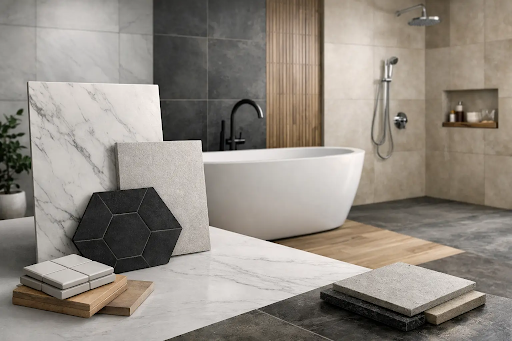
Bathroom floors take more abuse than almost any other surface in the house. They get splashed every day, soaked by the occasional overflow, and surrounded by steam after every hot shower. In Southern Maryland, the air adds its own moisture. Long, humid summers near the bay and rivers mean bathroom floors rarely get a chance to fully dry out.
The wrong material can warp, stain, crack, or trap mold underneath. The right one handles daily moisture for decades. If you’re planning bathroom remodeling in California, MD, your flooring choice deserves as much thought as your vanity or shower.
This guide compares the three most popular options, tile, vinyl, and natural stone, and explains what lies beneath the surface that matters just as much.
How humidity affects bathroom floors
Moisture reaches a bathroom floor in two ways. The obvious one is liquid water: drips from the tub, splashes from the sink, and puddles after a shower. The less obvious one is water vapor. Steam settles on cool surfaces, works its way into seams and grout lines, and can reach the subfloor over time.
Humidity also makes some materials swell and shrink. Wood-based products are the most vulnerable. That’s why solid hardwood and standard laminate are poor fits for full bathrooms. A good flooring choice for bathroom remodeling in California, MD needs to resist both standing water and constant humidity without changing shape.
Porcelain and ceramic tile
Tile is the traditional choice for bathroom floors, and for good reason. Properly installed, it’s one of the most water-resistant and long-lasting options available.
Porcelain is the stronger of the two. It’s made from denser clay fired at higher temperatures, so it absorbs very little water. That makes it an excellent choice for full bathrooms, steam-prone primary suites, and floors that continue into a curbless shower. Ceramic tile is softer and slightly more absorbent, but glazed ceramic still performs well on bathroom floors and often costs less.
Tile’s biggest strength is its range. It comes in large-format slabs, small mosaics, wood-look planks, stone-look finishes, and bold patterns. Large tiles mean fewer grout lines to clean. Small tiles add more grout, which improves grip, especially in shower areas.
The weak point is grout. Standard cement-based grout is porous and can absorb moisture and stains if it isn’t sealed. Sealing it after installation and resealing periodically helps. Many homeowners choose epoxy or high-performance grout instead, which resists stains and moisture far better.
Slip resistance matters too. Polished tile can get slick when wet. Look for tile rated for wet interior floors, which has a dynamic coefficient of friction of 0.42 or higher. Textured or matte finishes add extra grip. For many homeowners, tile is the default recommendation when planning bathroom remodeling in California, MD because it balances durability, style, and cost.
Luxury vinyl and sheet vinyl
Vinyl has come a long way. Today’s luxury vinyl plank and tile products look convincingly like wood or stone, feel warmer and softer underfoot than tile, and are often labeled waterproof.
Luxury vinyl comes in two main types. Rigid-core products have a stiff, stable core that resists denting and won’t swell when wet. Flexible glue-down products bond directly to the subfloor. Both resist moisture well, and both cost less to install than tile in most cases.
There’s one important detail. The planks themselves may be waterproof, but the seams and edges are not always watertight. In a full bathroom, water from a flood or a leaking toilet can slip between planks or around the perimeter and reach the subfloor. Installers can reduce this risk by sealing the perimeter with flexible caulk and choosing products with tight locking joints. Sheet vinyl, which covers the floor in one continuous piece, has very few seams and does an even better job of keeping water on the surface.
Vinyl suits powder rooms, kids’ bathrooms, guest baths, and budget-conscious projects. It’s also a good option over subfloors that can’t support the weight of tile or stone. Its main drawbacks are a shorter lifespan than tile and less resistance to sharp objects and heavy point loads. Still, it earns a place in plenty of plans for bathroom remodeling in California, MD.
Natural stone
Natural stone brings a look that nothing else quite matches. Marble, travertine, slate, limestone, and granite each have their own color, veining, and texture, and no two tiles are exactly the same.
Stone is also the most demanding of the three options. Most natural stone is porous and needs a penetrating sealer when installed, then resealing every year or two depending on the stone and how the bathroom is used. Marble and limestone are sensitive to acids, so some cleaners, toiletries, and even spilled mouthwash can etch the surface. Polished stone can be slippery when wet, so honed, tumbled, or textured finishes are better choices for floors.
Stone is heavy and less forgiving of movement. It needs a stiffer subfloor than ceramic tile to prevent cracks, which may mean adding framing support or a thicker underlayment in older homes.
The payoff is a floor that can last for generations and add real character to a primary bathroom. Slate and granite are generally the most durable choices for wet areas, while marble suits homeowners who accept that a little patina comes with the look.
A quick comparison
Here’s how the three materials stack up for humid bathrooms:
- Porcelain tile: very low water absorption, long lifespan, wide design range, and moderate cost, but colder underfoot and dependent on good grout.
- Ceramic tile: good water resistance when glazed, lower cost than porcelain, and plenty of styles, but softer and more prone to chipping.
- Luxury vinyl: waterproof surface, warm and comfortable, and budget-friendly, but seams and edges need care and the lifespan is shorter.
- Sheet vinyl: very few seams, easy cleaning, and the lowest cost, but fewer high-end looks.
- Natural stone: unique appearance and long life with proper care, but porous, heavier, and in need of regular sealing.
Each option can work well. The best one depends on how you use the room, your budget, and how much maintenance you’re willing to do.
What goes under the floor matters just as much
A beautiful floor won’t last if the layers beneath it fail. Moisture damage in bathrooms often starts in the subfloor, where nobody sees it until the floor feels soft or a stain shows up on the ceiling below.
Start with a solid, flat subfloor. Any rot or soft spots from past leaks should be repaired before new flooring goes down. Tile and stone need a rigid base, often cement backer board or an uncoupling membrane, to prevent cracking.
Add waterproofing where it counts. A waterproof membrane under tile creates a barrier that stops water from reaching the wood below, even if grout lines let some moisture through. In wet areas like curbless showers and the zone around the tub, this layer is essential. For bathroom remodeling in California, MD, where humidity stays high for much of the year, many homeowners extend waterproofing across the entire floor.
Seal the edges. Gaps around the tub, toilet, and walls are common entry points for water. Flexible sealant at these joints keeps moisture on the surface.
Consider radiant heat. Heated floors work well under tile and stone, taking the chill off hard surfaces and helping the floor dry faster after showers.
Ventilation protects whatever floor you choose
Even the most water-resistant floor benefits from good airflow. An exhaust fan sized for the room and vented to the outdoors, not into the attic, removes moist air before it settles. Run it during showers and for about 20 minutes afterward. A fan on a timer or humidity sensor makes this automatic.
Good ventilation also protects grout, paint, cabinets, and drywall. It’s a small part of the budget that pays off across the whole room, which is why it belongs in every plan for bathroom remodeling in California, MD.
How to choose the right floor for your bathroom
Start with how the room gets used. A busy family bathroom with kids and frequent splashing calls for durable, low-maintenance porcelain tile or sheet vinyl. A primary suite where you want a spa-like feel may be the place for natural stone or large-format porcelain. A powder room with no shower can use almost any water-resistant material, including luxury vinyl.
Think about maintenance honestly. If resealing stone every year sounds like a chore you’ll skip, porcelain with a stone look may be a better fit. Consider comfort too. Vinyl is warmer underfoot, while tile and stone feel best with radiant heat.
Finally, see and touch samples in person. Colors and textures look different under bathroom lighting, and a material that seemed perfect online may feel different in your hand.
Plan your bathroom floor with Southern Maryland Kitchen Bath Floors & Design
The right bathroom floor stands up to daily water, steam, and the humid Southern Maryland climate while still looking the way you want. Getting it right depends on choosing the right material and installing it over the right foundation.
Southern Maryland Kitchen Bath Floors & Design helps homeowners plan and complete bathroom remodeling in California, MD and across the surrounding region. Our showroom on Three Notch Road lets you compare tile, luxury vinyl, natural stone, heated flooring, fixtures, and countertops side by side. Our designers provide consultations and 3D renderings, and our licensed, in-house team handles installation with a detailed scope and fixed-price contract before work begins.
Ready to choose a floor that lasts? For a consultation, contact Southern Maryland Kitchen Bath Floors & Design to begin planning your bathroom remodel in California, MD.