
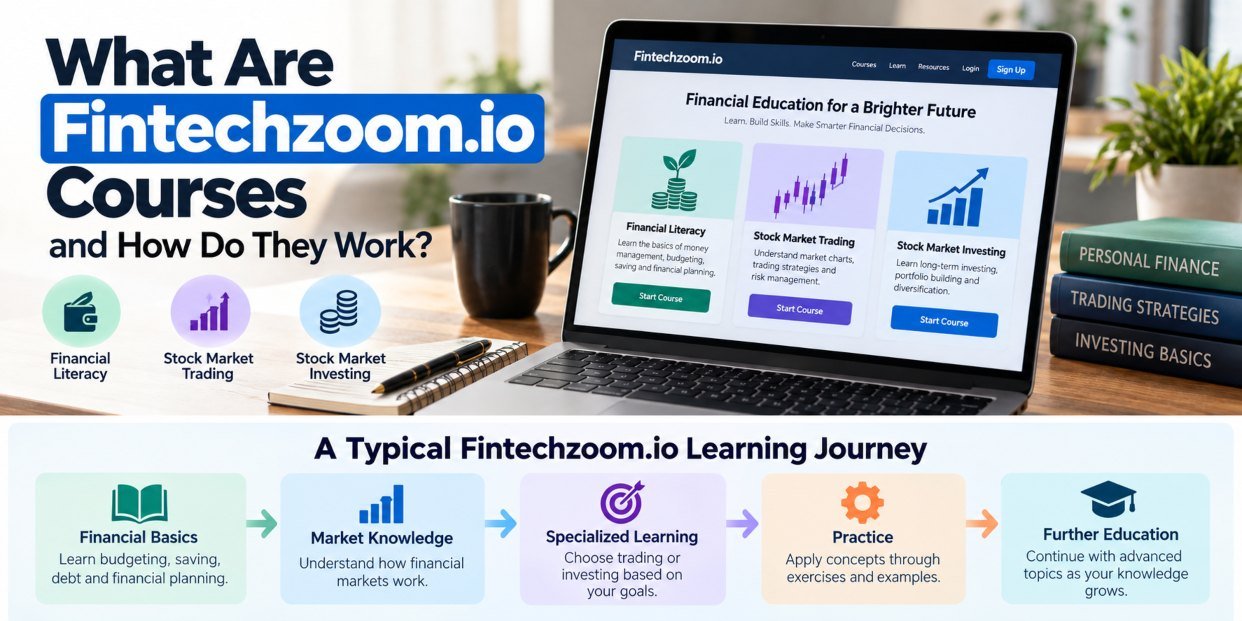
Online financial education can help people understand money management, investing, and trading without following a traditional classroom schedule. Fintechzoom.io Courses focus on these areas through educational programs designed for people with different levels of financial knowledge.
The course selection focuses mainly on financial literacy, stock market trading, and stock market investing. These subjects serve different purposes. Someone who wants better control over everyday finances may have different learning needs from someone who wants to understand trading charts or build a long-term investment portfolio.
Understanding the course topics is only one part of choosing an online finance course. Learners should also look at the course structure, learning materials, access terms, instructor information, pricing, certificates, and refund conditions.
This guide explains what Fintechzoom.io Courses are, what they cover, how the learning process works, how the courses differ, and what learners should check before enrolling.
What Are Fintechzoom.io Courses?
Fintechzoom.io Courses refer to online educational programs that focus mainly on personal finance, stock market trading, and investing.
The courses aim to organize financial topics into a more structured learning format. Instead of reading separate articles about budgeting, stocks, investing, or trading, learners can follow a course built around a specific financial subject.
The main course areas include:
- Financial literacy
- Stock market trading
- Stock market investing
Each area targets a different learning goal.
Financial literacy focuses on managing money. It can include budgeting, saving, debt management, credit, financial planning, and basic investing.
Stock market trading focuses more on active participation in financial markets. Topics may include charts, market movements, trading strategies, indicators, risk management, and trading psychology.
Stock market investing takes a longer-term approach. It focuses on areas such as asset classes, portfolio building, diversification, investment research, risk, and long-term financial goals.
The courses also differ from normal financial articles. An article usually answers one question or explains one topic. A course should provide a more organized learning path where one lesson builds on another.
That structure can help learners understand how different financial concepts connect instead of studying isolated topics.
What Topics Do Fintechzoom.io Courses Cover?
The main Fintechzoom.io course categories cover different parts of personal finance and financial markets.
Financial Literacy

Financial literacy provides a foundation for understanding how money works in everyday life.
Major topics can include:
- Creating and managing a budget
- Tracking income and expenses
- Building savings
- Managing debt
- Understanding credit
- Creating an emergency fund
- Setting financial goals
- Basic investing
- Financial planning
Someone who has never studied finance may find these topics useful before moving into more advanced trading or investing subjects.
Budgeting helps learners understand where their money goes. Saving teaches them how to prepare for future expenses. Debt management explains how borrowing affects personal finances.
These basic skills can also make later investment concepts easier to understand.
Stock Market Trading
Stock market trading focuses on buying and selling financial assets based on market conditions and trading strategies.
Common learning areas include:
- Stock market basics
- Trading terminology
- Price charts
- Candlestick patterns
- Market trends
- Technical indicators
- Day trading
- Swing trading
- Position trading
- Stop-loss orders
- Risk management
- Trading psychology
Trading usually requires frequent market analysis. A trading course may therefore focus heavily on understanding price movement and managing risk.
Learning how markets work does not remove financial risk. It helps learners understand the tools and concepts that traders use when making decisions.
Stock Market Investing
Stock market investing focuses more on building wealth over longer periods.
Important subjects may include:
- Investment fundamentals
- Stocks
- Bonds
- Exchange-traded funds
- Mutual funds
- Asset allocation
- Portfolio building
- Diversification
- Investment research
- Risk and reward
- Long-term investment strategies
- Market analysis
- Portfolio management
An investing course may also explain how economic conditions, company performance, and investor behavior can affect investment decisions.
The main goal is usually to help learners understand how to create and manage an investment plan rather than react to every short-term market movement.
Fintechzoom.io Courses at a Glance
The three main course areas serve different purposes.
| Course | Main Focus | Suitable For | Main Learning Goal |
| Financial Literacy | Personal finance | Beginners | Improve financial knowledge |
| Stock Market Trading | Active market trading | Aspiring traders | Understand trading concepts |
| Stock Market Investing | Long-term investing | New investors | Learn portfolio building |
This comparison shows why learners should first identify what they actually want to learn.
Someone who wants to improve budgeting may not need a trading course. Someone who already understands personal finance but wants to research stocks may find investment education more relevant.
How Do Fintechzoom.io Courses Work?
The learning process generally starts with choosing a course that matches your financial knowledge and goals.
A structured approach can make the learning experience easier.
Step 1: Choose a Course Based on Your Goal
Start by asking what you want to understand.
If your main goal involves everyday money management, financial literacy may provide the most relevant subjects.
If you want to understand active market participation, charts, and trading strategies, a trading course may match that goal.
If you want to understand portfolios and long-term wealth building, investing may be more suitable.
Your existing knowledge also matters.
Someone who does not understand budgeting, interest, risk, or basic investment terms may benefit from building financial knowledge before studying advanced market strategies.
Step 2: Access the Course Lessons
Online finance courses usually organize information into lessons or modules.
Self-paced learning lets students work through lessons according to their own schedule rather than attending a fixed classroom session.
A course module may focus on one main subject before moving to the next.
For example, an investing course may begin with investment basics before discussing asset classes, diversification, portfolio management, and more advanced investment concepts.
This order matters because advanced financial ideas often depend on basic concepts.
Step 3: Learn Through Course Materials
Course materials can make financial concepts easier to study.
Depending on the individual program, learning materials may include:
- Video lessons
- Written information
- Worksheets
- Charts
- Practical examples
- Exercises
- Strategy guides
- Financial planning tools
Different formats serve different purposes.
Videos can explain concepts visually. Worksheets can help learners apply financial ideas. Charts can make trading concepts easier to understand. Exercises can test whether a learner has understood a lesson.
Students should check the current course page before enrolling to confirm exactly which materials come with the course.
Step 4: Complete Quizzes or Practical Activities
Reading or watching a lesson does not always mean that someone fully understands the topic.
Quizzes and exercises can help learners identify gaps in their knowledge.
For example, a financial literacy quiz could test understanding of budgeting, debt, or credit.
A trading exercise might ask learners to identify a chart pattern or explain a risk management concept.
An investing activity could involve creating a sample asset allocation.
These activities can help turn passive learning into active practice.
Step 5: Complete the Course
Course completion usually means working through the required learning materials and any related activities.
If the program provides a certificate, learners should understand what the certificate represents.
A course completion certificate usually shows that someone finished a specific educational program. It does not automatically equal a university degree, professional license, or regulated financial qualification.
Anyone who needs a certificate for employment or professional development should check its recognition before enrolling.
What Does a Typical Fintechzoom.io Learning Journey Look Like?
A beginner can approach financial education in stages rather than trying to understand everything at once.
A practical learning path may look like this:
Financial Basics → Market Knowledge → Specialized Learning → Practice → Further Education
A complete beginner may start by understanding income, expenses, budgeting, saving, debt, interest, and financial goals.
The next stage can involve learning how financial markets operate.
After understanding the basics, the learner can decide whether trading or investing matches their interests.
Trading focuses more on active market decisions.
Investing generally focuses more on long-term asset ownership and portfolio management.
The learner can then practice concepts through exercises, sample portfolios, charts, or hypothetical examples before considering more advanced education.
Which Fintechzoom.io Course Matches Different Learning Goals?
The right learning path depends on what someone wants to understand.
For People New to Personal Finance
Financial literacy may suit people who want to improve basic money management skills.
Typical subjects include budgeting, saving, debt, credit, expenses, financial goals, and basic investing.
These subjects also create a useful foundation for more advanced financial education.
For People Interested in Active Trading
The Stock Market Trading course focuses more closely on active financial markets.
Someone interested in charts, market trends, trading strategies, indicators, and shorter-term price movement may find these subjects more relevant.
Trading also involves risk, so risk management should remain an important part of the learning process.
For People Interested in Long-Term Investing
The Stock Market Investing course focuses more on building and managing investments over time.
Learners may study asset classes, diversification, portfolio allocation, investment research, risk, compounding, and different investment approaches.
This learning path may suit people who want to understand how long-term portfolios work.
Fintechzoom.io Trading Course vs Investing Course
Trading and investing both involve financial markets, but they approach them differently.
| Factor | Trading Course | Investing Course |
| Primary Goal | Understand active market trading | Build long-term investing knowledge |
| Time Horizon | Usually shorter | Usually longer |
| Main Analysis | Charts and market movement | Assets, companies, and portfolios |
| Activity Level | More active | Generally less frequent |
| Risk Focus | Trade-level risk | Portfolio-level risk |
| Typical Learner | Aspiring trader | Long-term investor |
Trading education may focus more on market timing, charts, entries, exits, indicators, and short-term risk.
Investment education may focus more on asset quality, diversification, long-term growth, portfolio construction, and financial objectives.
Some concepts overlap. Both traders and investors need to understand risk, market behavior, financial assets, and decision-making.
The difference mainly comes from how they use that information.
Financial Literacy vs Trading vs Investing Course
The three learning areas also differ in difficulty and practical use.
Financial literacy provides the broadest foundation. It deals with everyday money decisions and basic financial planning.
Trading involves more specialized market knowledge. Learners may need to understand technical terms, charts, market orders, risk controls, and trading strategies.
Investing also requires market knowledge, but it places greater attention on long-term goals, portfolio construction, asset analysis, and diversification.
A person can compare them using five questions:
- What do I already know about finance?
- What do I want to learn?
- Do I want everyday financial skills or market skills?
- Am I interested in active trading or long-term investing?
- How much time can I dedicate to learning and practice?
These questions can make course selection more practical.
Which Course Should a Complete Beginner Study First?
A complete beginner should focus on building a strong understanding of basic financial concepts before moving into complex subjects.
Financial literacy can help learners understand budgeting, saving, debt, credit, interest, risk, and investing basics.
Once those ideas become clear, a learner can decide whether trading or investing deserves deeper study.
However, not every beginner starts from the same point.
Someone may already understand budgeting and saving but know very little about financial markets. That person may move directly into introductory investment education.
Another learner may understand long-term investing but want to learn chart analysis and trading.
The starting point should depend on existing knowledge and learning goals.
What Should You Check Before Enrolling in a Fintechzoom.io Course?
Course topics alone should not determine whether someone enrolls.
Several practical details deserve attention.
Check the Current Course Syllabus
A course title gives only a broad idea of the subject.
Review the syllabus and look for:
- Course modules
- Lesson topics
- Learning outcomes
- Difficulty level
- Practical activities
- Advanced subjects
A detailed syllabus helps you understand whether the course covers information you actually need.
Check Who Created or Teaches the Course
Instructor experience matters in financial education.
Before paying, look for information such as:
- Instructor name
- Professional background
- Relevant experience
- Education
- Public credentials
- Areas of expertise
Do not assume expertise based only on marketing language.
Check the Current Course Price
Course prices can change.
Always check the current price before enrolling.
Also determine whether the listed amount covers everything or whether the course includes additional charges for materials, advanced modules, certificates, memberships, or other services.
Check Course Access Terms
Understand how access works before making a payment.
Useful questions include:
- How long will I have access?
- Can I revisit completed lessons?
- Can I access course updates?
- Do I need an account?
- Can I use the course on different devices?
- What happens if the platform changes?
Clear access terms help prevent confusion later.
Check the Refund Policy
Review the refund conditions carefully.
Check:
- Refund period
- Eligibility requirements
- Exclusions
- Cancellation process
- How to request a refund
- Expected refund method
Do not rely only on a short promotional statement. Read the current terms.
Check Whether a Certificate Is Included
Some online courses provide certificates after completion.
Confirm whether the certificate comes with the course or requires an additional fee.
You should also check what learners must do to receive it.
Check Whether the Certificate Has External Recognition
A certificate of completion and a professional financial qualification are not the same thing.
A course completion certificate confirms participation or completion.
An industry certification may require a formal examination and specific professional standards.
A university qualification comes from an accredited educational institution.
A professional financial credential may also require training, examinations, experience, and ongoing professional requirements.
Check which category applies before using a certificate for employment or professional purposes.
Check Course Update Dates
Financial information can become outdated.
Markets, financial tools, platforms, products, regulations, and technology continue to change.
Check when the course received its latest update.
Current examples and updated lessons can make financial education more useful.
Fintechzoom.io vs Fintechzoom.com: Are They the Same?
Fintechzoom.io and Fintechzoom.com use similar names, but users should not assume that similar domain names belong to the same website, business, or organization.
A different domain extension can represent a completely separate website.
This matters even more when a website asks users to:
- Create an account
- Enter personal information
- Pay for a product
- Provide financial information
- Subscribe to a service
Before completing any of these actions, verify the exact website you are using.
Do not assume ownership or affiliation simply because two sites have similar names, branding, or topics.
How to Verify You Are Using the Correct Fintechzoom.io Website
A few basic checks can reduce confusion.
Check the Domain Spelling
Read the complete domain in your browser.
Look carefully for:
- Extra letters
- Missing letters
- Different domain extensions
- Unusual subdomains
- Similar spellings
Review the About Page
An About page can explain who operates the website and what services it provides.
Look for clear information rather than relying only on promotional claims.
Review Contact Information
Check whether the website provides working contact details.
These may include:
- Email address
- Contact form
- Business information
- Support details
Read the Terms and Privacy Policy
Terms can explain payment, refunds, access, responsibilities, and limitations.
The privacy policy should explain how the site handles personal information.
Verify Payment Information
Before entering card or banking details, confirm:
- The exact website
- The product being purchased
- The total amount
- Renewal conditions
- Refund terms
- Payment processor
Confirm the Exact Course Page
Make sure the course title, curriculum, cost, and included materials match what you intend to buy.
Questions to Ask Before Taking Any Online Finance Course
A useful finance course should provide enough information for learners to make an informed decision.
Ask these questions before enrolling:
- What exactly will I learn?
- Does the course match my current knowledge?
- Who created the lessons?
- What relevant experience does the instructor have?
- When did the course receive its latest update?
- Can I preview any lessons?
- Does the course include learner support?
- What does the refund policy cover?
- Does the certificate have external recognition?
- Are there additional fees?
- How long will I have access?
- Does the course explain financial risk clearly?
Clear answers can help learners compare different programs more effectively.
What Skills Can You Expect to Develop?
The skills depend on the selected learning path.
Personal Finance Skills
Financial literacy can help develop skills related to:
- Budgeting
- Saving
- Expense tracking
- Debt management
- Financial goal setting
- Basic financial planning
These skills apply directly to everyday money management.
Trading Skills
Trading education may help learners understand:
- Market terminology
- Price charts
- Candlestick patterns
- Market trends
- Technical indicators
- Trading strategies
- Risk controls
- Trading psychology
Learning these concepts does not guarantee profitable trades. It provides knowledge that can help someone better understand how trading works.
Investing Skills
Investment education can develop knowledge related to:
- Asset classes
- Portfolio construction
- Diversification
- Risk and return
- Investment research
- Market analysis
- Long-term planning
- Portfolio management
These skills can help learners understand how investment decisions fit into larger financial goals.
What Fintechzoom.io Courses Cannot Replace
Financial education has limits.
An online course cannot replace personalized financial advice from a qualified professional who understands your individual situation.
It also cannot guarantee investment returns.
Financial markets involve uncertainty. Stocks and other assets can rise or fall in value.
A course also does not automatically replace a professional financial qualification.
Learning about trading does not make someone a licensed financial professional.
Completing an investing course does not remove the need for independent research.
Courses provide education. Learners still need experience, critical thinking, practice, and responsible decision-making.
How to Get More Value From Fintechzoom.io Courses
A learner’s study habits can affect how much value they receive from any online course.
- Take structured notes instead of simply watching each lesson.
- Create a glossary for financial terms that you do not understand.
- Review difficult modules more than once.
- Complete quizzes without immediately checking the answers.
- Use worksheets when available.
- Practice investing concepts with hypothetical portfolios before using real money.
- Practice chart analysis without assuming that every pattern predicts future prices.
- Write down questions that remain unclear and research them further.
- Compare important financial concepts with reliable educational and regulatory resources.
- Most importantly, separate education from financial promises.
- Learning more about markets can improve understanding, but it cannot remove risk.
Are Fintechzoom.io Courses Suitable for Beginners?
Some of the subject areas can suit beginners because they start with basic financial concepts.
- Financial literacy provides the clearest entry point for someone with little financial knowledge.
- Trading and investing can also include beginner-level material, but certain sections may require more study.
- Terms such as asset allocation, technical indicators, portfolio rebalancing, market orders, volatility, and risk-adjusted return can take time to understand.
- Beginners should not rush through these concepts.
- Building understanding matters more than finishing a course quickly.
How Long Does It Take to Complete Fintechzoom.io Courses?
Course completion time depends on the program and the learner.
- The number of hours of video or written lessons does not always equal the actual learning time.
- For example, a learner may spend one hour watching a lesson but another hour reviewing notes, completing exercises, researching unfamiliar terms, and repeating difficult concepts.
- Self-paced learning makes this easier because learners can adjust their schedule.
- Someone with existing financial knowledge may progress faster than a complete beginner.
- Course duration should therefore act as a general guide rather than a measure of how long someone needs to understand the material properly.
Are Fintechzoom.io Courses Free or Paid?
Course availability and pricing can change, so users should check the current course page before enrolling.
Do not assume that every course, lesson, certificate, or learning resource follows the same pricing model.
Check whether access includes:
- Complete lessons
- Worksheets
- Quizzes
- Support
- Updates
- Certificates
- Future course access
If payment is required, review the final price and terms before completing the transaction.
Do Fintechzoom.io Courses Provide Certificates?
Course descriptions may include a completion certificate as part of the learning experience.
However, learners should verify the current certificate terms directly on the specific course page.
More importantly, understand what the certificate represents.
A completion certificate can document that you finished a course.
It does not automatically provide professional authorization to offer financial advice, manage investments, or perform regulated financial services.
People who need a recognized qualification for employment should check whether employers, educational institutions, professional organizations, or regulators recognize the credential.
Frequently Asked Questions
What are Fintechzoom.io Courses?
Fintechzoom.io Courses are online financial education programs that focus on subjects such as financial literacy, stock market trading, and stock market investing.
How do Fintechzoom.io Courses work?
Learners select a course, work through its lessons and learning materials, complete available exercises or quizzes, and finish the required course content. The exact structure can differ between courses.
What courses are available on Fintechzoom.io?
The main course areas include Financial Literacy, Stock Market Trading, and Stock Market Investing.
Are Fintechzoom.io Courses suitable for beginners?
Some courses cover beginner-level topics. Financial literacy may suit complete beginners, while trading and investing courses can introduce more specialized financial concepts.
Is the Fintechzoom.io Stock Market Trading Course different from its Investing Course?
Yes. Trading focuses more on market movements, charts, trading strategies, and active risk management. Investing focuses more on long-term portfolios, asset allocation, diversification, and investment research.
How long do Fintechzoom.io Courses take?
Completion time depends on the course, the amount of material, and the learner’s experience. Students should also allow extra time for notes, exercises, revision, and independent study.
Are Fintechzoom.io Courses free?
Pricing and course access can change. Check the current course page to confirm whether a specific course requires payment and what the price includes.
Does Fintechzoom.io provide course certificates?
Some course information may mention certificates after completion. Learners should check the current course terms to confirm availability and requirements.
Are Fintechzoom.io certificates professionally recognized?
A course completion certificate should not automatically be treated as a professional qualification. Learners should verify external recognition if they need the certificate for employment, licensing, or professional development.
What should I check before enrolling in Fintechzoom.io Courses?
Check the syllabus, instructor information, course price, access period, refund policy, learning materials, update date, support options, and certificate terms.
Is Fintechzoom.io the same as Fintechzoom.com?
The websites use different domain names. Users should not assume that websites with similar names belong to the same organization. Verify ownership, contact details, course information, and the exact domain before creating an account or making a payment.
Conclusion
Fintechzoom.io Courses focus on three major areas of financial education: financial literacy, stock market trading, and stock market investing.
Each learning path serves a different purpose. Financial literacy focuses on everyday money management. Trading focuses on active markets, charts, strategies, and risk controls. Investing focuses on portfolios, diversification, asset research, and longer-term financial planning.
Understanding the subjects is important, but learners should also evaluate how a course works before enrolling.
Check the syllabus, instructor information, course materials, current price, refund conditions, access terms, update history, and certificate details. Also verify the exact website and domain before submitting personal or payment information.
A finance course can help organize learning and explain difficult financial concepts. It should still form only one part of financial education. Independent research, practice, risk awareness, and continued learning remain important when dealing with personal finance and financial markets.